A practical guide to share capital exercises under the Companies Act 2016 and their potential impact on SME tax eligibility
Share capital is more than just a figure appearing in a company’s SSM records. As a business grows, a company may need to increase its paid-up share capital, issue new shares, bring in new investors, convert existing obligations into equity, or reduce its share capital as part of a corporate restructuring.
However, a share capital exercise should be properly planned. Apart from compliance with the Companies Act 2016 (“CA 2016”), changes to a company’s paid-up ordinary share capital may also affect its eligibility for the SME preferential tax rate under the Income Tax Act 1967 (“ITA 1967”).
This guide explains the common share capital exercises in Malaysia, how companies can increase or reduce their share capital, and the key corporate and tax considerations to look at before proceeding.
1. What Is Share Capital Under the Companies Act 2016?
Under the CA 2016, a “share” refers to the issued share capital of a corporation and includes stock, unless a distinction between shares and stock is expressly or impliedly made.
In practical terms, a share represents an ownership interest in a company, while share capital represents the capital contributed to the company through the issuance of shares.
Since the CA 2016 came into effect, Malaysia has abolished the concepts of par value and authorised share capital. Companies therefore generally focus on their issued shares and paid-up share capital.
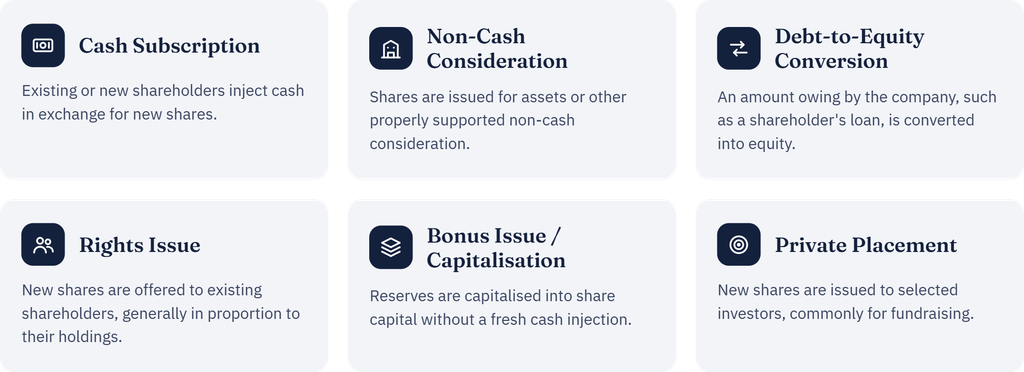
Share capital can arise from different forms of consideration:

Share Capital Is Not the Same as Cash in the Bank
A company with RM1 million in paid-up share capital does not necessarily have RM1 million sitting in its bank account.
The funds may already have been used to purchase assets, pay operating expenses or fund the company’s business activities. Likewise, certain share capital exercises may involve non-cash consideration, meaning no fresh cash is injected into the company.
2. How Can a Company Increase Its Share Capital in Malaysia?
A company may increase its paid-up share capital through several methods, depending on the purpose and structure of the transaction.
Allotment of New Shares for Cash
This is one of the most common methods of increasing paid-up share capital. New shares are issued and allotted to an existing shareholder or new investor in exchange for cash.
Before the directors exercise their power to allot shares, the company should consider whether prior shareholder approval is required under Section 75 of the CA 2016, together with any applicable exceptions and the company’s constitution. Following the allotment, the prescribed Return for Allotment of Shares under Section 78 must be lodged with SSM within the applicable timeframe.
Allotment for Non-Cash Consideration
Not every increase in share capital requires fresh cash. Shares may also be issued for non-cash consideration, such as assets or through an appropriately structured debt-to-equity conversion, where an amount owing by the company is converted into shares.
The nature and value of the consideration should be properly supported and documented, with the relevant details reflected in the corporate and statutory records.
Rights Issue, Bonus Issue and Private Placement
Depending on the company’s objective, other methods may include:
- a rights issue, where shares are offered to existing shareholders;
- a bonus issue or capitalisation, where reserves are capitalised without fresh cash being injected; or
- a private placement, where new shares are issued to selected investors.
The appropriate method should be determined based on the company’s funding needs, ownership structure and commercial objectives.
3. Reducing or Restructuring Share Capital
While companies commonly increase share capital to raise funds, there may also be circumstances where a company wishes to reduce its existing share capital.
A capital reduction may be undertaken for purposes such as:
- cancelling paid-up capital that is lost or no longer represented by available assets;
- returning capital that is in excess of the company’s needs to shareholders; or
- reducing liability in respect of unpaid share capital.
Under Section 115 of the CA 2016, a company may generally reduce its share capital through one of two statutory routes.
| Route | General Process |
|---|---|
| Court Order Procedure (Section 116) | Special resolution followed by confirmation of the reduction by the Court |
| Solvency Statement Procedure (Section 117) | Special resolution supported by the applicable solvency and statutory requirements |
Court Order Procedure – Section 116
Under this route, the company passes a special resolution to reduce its share capital and obtains confirmation from the High Court.
The court has powers under Section 116(2), CA 2016 to inquire into the position of creditors, particularly where the reduction involves diminution of unpaid liability or repayment of paid-up capital to shareholders. This route is more time-consuming, typically 2–3 months or longer from filing to court order but remains necessary in more complex or contested reductions,
Solvency Statement Procedure – Section 117
The Section 117 route provides an alternative to the Court procedure, subject to compliance with the applicable requirements under the CA 2016.
Depending on the nature of the reduction, the process may involve a special resolution, solvency statement, statutory notices, creditor objection period and the relevant SSM lodgements. SSM currently prescribes filings for the proposed reduction under Section 117 and the subsequent notice of reduction under Section 119.
A share capital reduction is therefore not simply a change to the company’s SSM records. The exercise must be properly structured and the statutory steps completed in the correct sequence.
Key procedural requirements include:
- All directors must make a solvency statement confirming the company can pay its debts as they fall due for 12 months following the reduction (Section 117(3));
- The solvency statement need not be made where the reduction is solely to cancel paid-up capital that is lost or unrepresented by available assets (Section 117(4));
- The solvency statement (or a copy) must be made available for inspection by creditors, without charge, at the registered office for six weeks from the date of the resolution;
- The company must advertise notice of the reduction within seven days of the resolution, in two widely circulated newspapers, one Bahasa Malaysia and one English;
- Creditors have a statutory right to apply to the High Court within six weeks from the date of the resolution to object to and seek cancellation of the reduction (Section 118).
This route can typically be completed within 6–8 weeks, making it the preferred mechanism for most private companies undertaking straightforward capital reductions. For example, cleaning up accumulated losses, right-sizing paid-up capital ahead of a restructuring or share transfer, or returning surplus capital to shareholders.
4. Does Share Capital Affect the SME Tax Rate in Malaysia?
Yes. A company’s paid-up ordinary share capital is one of the key factors in determining its eligibility for the SME preferential corporate tax rates in Malaysia.
Under Schedule 1 of the Income Tax Act 1967 (“ITA 1967”), the relevant qualifying conditions include:
- Paid-up Capital: Paid-up ordinary share capital of not more than RM2.5 million at the beginning of the relevant basis period;
- Gross Business Income: Gross income from business sources of not more than RM50 million for the relevant year of assessment;
- Foreign Shareholding: Not more than 20% of the paid-up ordinary share capital is directly or indirectly owned by foreign companies or non-Malaysian citizens; and
- Other Conditions: Compliance with the applicable related-company, ownership and other statutory requirements.
Foreign Shareholding Restriction – Effective YA 2024
With effect from Year of Assessment 2024, an additional restriction was introduced under Paragraph 2B(d), Part I, Schedule 1 of the ITA 1967, through the Finance Act 2023.
Under this provision, companies with more than 20% foreign ownership, whether directly or indirectly held by foreign companies or non-Malaysian citizens, are generally not eligible for the SME preferential tax rates.
This means companies should consider not only their paid-up share capital but also their shareholding structure, particularly when issuing new shares to foreign investors.
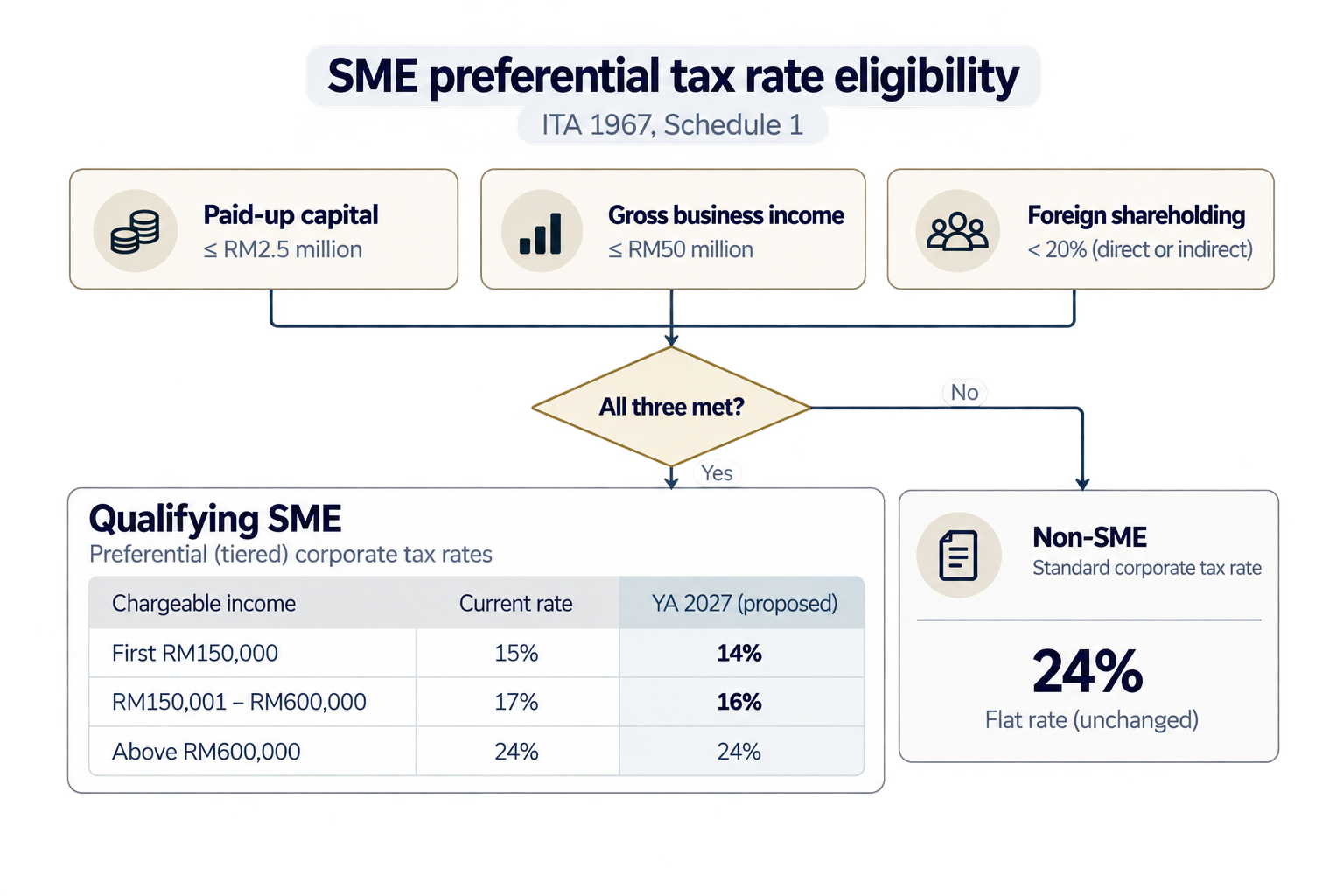
Note: Conditions tested at the start of the basis period for the relevant year of assessment. YA2027 rates proposed in Budget 2027 (9 Oct 2026), subject to legislative approval.
Example: Tax Impact on RM600,000 Chargeable Income
Assume two Malaysian resident companies each have RM600,000 in chargeable income, but only one qualifies for the SME preferential tax rates.
| Tax Computation | Qualifying SME | Non-SME |
|---|---|---|
| First RM150,000 | RM22,500 (15%) | RM36,000 (24%) |
| Next RM450,000 | RM76,500 (17%) | RM108,000 (24%) |
| Total Tax Payable | RM99,000 | RM144,000 |
Potential Tax Difference: RM45,000
In this simplified example, the qualifying SME pays RM45,000 less in corporate income tax than a company taxed at the standard 24% rate.
This illustrates why share capital planning should take into account the company’s tax position, particularly where an increase in paid-up ordinary share capital may affect SME tax eligibility.
Note: This illustration assumes the relevant tax rates apply and excludes other tax adjustments, reliefs and incentives.
Update: Proposed SME Corporate Tax Rates from YA 2027
Under Malaysia’s Budget 2027, announced on 9 October 2026, the Government proposed reducing the preferential corporate income tax rates for qualifying SMEs from 15% to 14% and 17% to 16%, while maintaining the 24% rate on chargeable income exceeding RM600,000, effective from Year of Assessment 2027, subject to legislative approval.
Source: Ministry of Finance Malaysia – Budget 2027 Speech.
Why Should This Be Considered Before Increasing Share Capital?
Consider a company with paid-up ordinary share capital of RM2.4 million. If it undertakes a further share allotment of RM600,000, its paid-up ordinary share capital would increase to RM3 million.
The company should therefore review the potential impact on its SME tax eligibility before completing the share capital exercise, particularly because the tax rules look at the company’s paid-up capital at the beginning of the relevant basis period.
This consideration can arise regardless of whether the increase comes from a cash subscription, rights issue, capitalisation or another form of share issuance.
Key takeaway: A share capital exercise that is perfectly valid from a company law perspective may still have tax implications. Corporate and tax considerations should therefore be reviewed together before implementation.
5. Can a Share Capital Reduction Affect SME Tax Eligibility?
Where a company’s paid-up ordinary share capital exceeds RM2.5 million, a capital reduction may change its capital position.
However, reducing the share capital to RM2.5 million or below does not automatically mean that the company will qualify for the SME preferential tax rate.
The timing of the reduction is important, and the company must still satisfy the other applicable requirements under the ITA 1967, including the relevant income and ownership conditions.
Accordingly, where a capital reduction is being considered partly because of the company’s tax position, the proposed structure and timing should be reviewed with the company’s company secretary and tax adviser before implementation.
6. Common Mistakes to Avoid in Share Capital Exercises
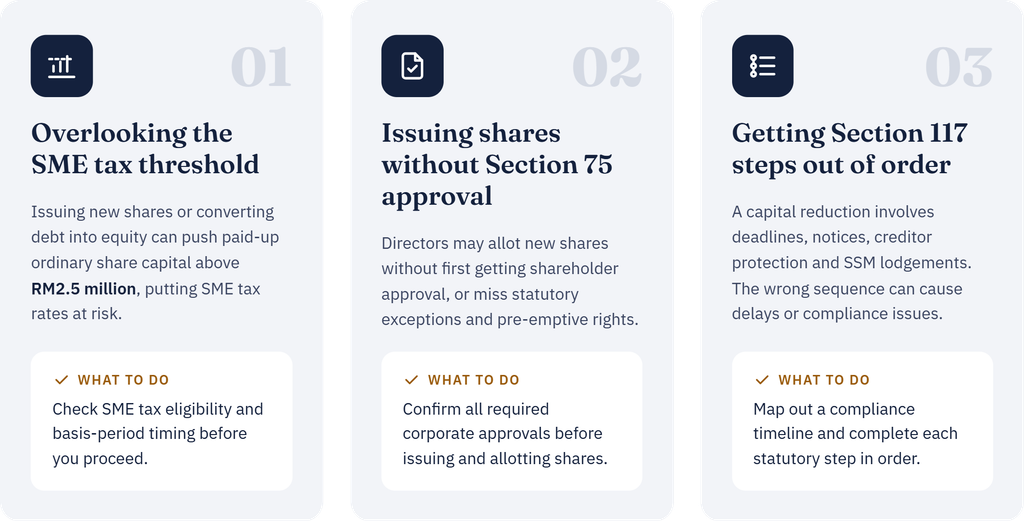
Even a straightforward share capital exercise can create compliance or tax issues if it is not properly planned.
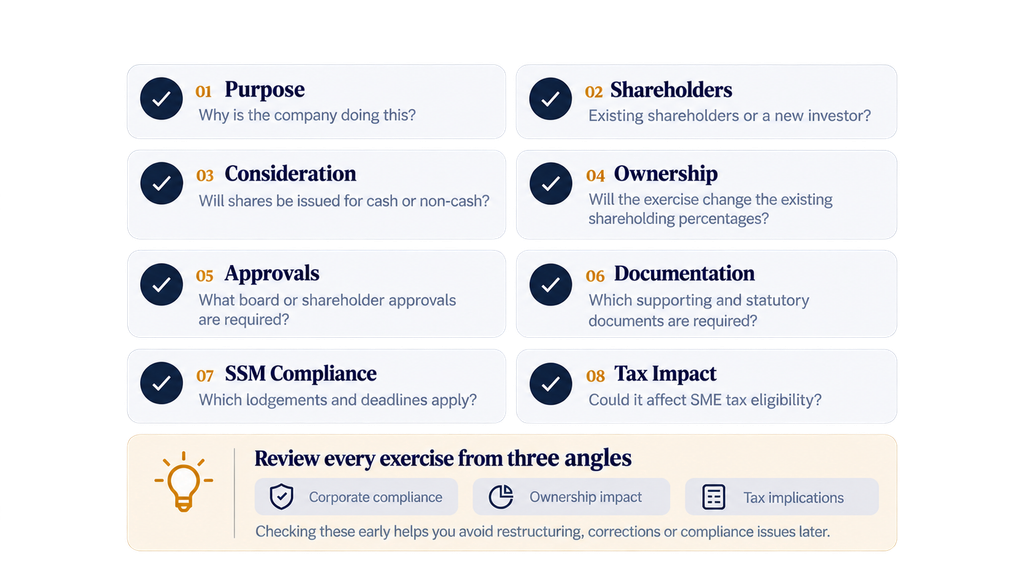
7. Share Capital Exercise: What Should You Check Before Proceeding?
Before increasing, restructuring or reducing share capital, companies should consider these key questions:
How POSH Can Help
A share capital exercise involves more than just an SSM filing. The corporate requirements, documentation, timing and potential tax implications should be considered before implementation.
At POSH, we assist companies with share allotments, capitalisation exercises and share capital reductions, including the necessary corporate approvals, statutory documentation and SSM lodgements.
As a licensed tax firm, we also provide tax advisory support to assess the potential tax implications of proposed share capital exercises, including their impact on the company’s eligibility for the SME preferential tax rates.
Planning to increase or reduce your company’s share capital in Malaysia? Contact POSH Corporate Services before proceeding. Proper planning can help ensure that both corporate compliance and tax implications are considered from the outset.
This article is intended for general information only and does not constitute legal, accounting or tax advice. The applicable requirements depend on the circumstances of each company, and professional advice should be obtained before undertaking a share capital exercise.